VideoGenius
VideoGenius is deprecated. It’s no longer available in the Plainly web app, and its API endpoints will be removed in a future release.
VideoGenius is an AI-powered video creation tool built on top of Plainly’s core functionality, designed to turn article content into amazing videos that use After Effects templates as a base.
It streamlines the entire video production process — from raw text to polished video — through smart automation and AI-driven enhancements.
Key features of VideoGenius include:
- AI summarization - condenses long-form articles into concise, video-ready scripts.
- Automated asset selection - automatically picks the most relevant images, footage, and videos based on your content.
- Voiceover generation - produces natural-sounding voiceover to bring your scripts to life.
- Template-based rendering - uses customizable After Effects templates to ensure every video looks on-brand and professional.
Setup
Setting up VideoGenius is quite simple and straightforward, and consists of a few steps:
Create brand
A brand represents a set of standards that will be used across all the videos that use this brand. You can have as many brands as you want.
Start by navigating to the Brands page, then click the New brand + button.
When creating a brand you need to set up its Name, Logo URL, Website URL, and Language.
Language is used to set the default language for the videos that will be created using this brand. You can change it later on the video level as well.
Upon creating a brand, you will be redirected to the brand details page.
Create video type
Video type is a set of rules that will be used to create the video. You can have as many video types per brand as you want. All enabled video types will be rendered whenever you add a new article for this brand.
To create a new video type, on the Brand details page, click Add new under the Video types section.
Things to keep in mind
- Having multiple video types per brand will trigger multiple video renders for the same article.
- Use the duplicate option to create a new video type based on the existing one. This can be useful if you want to create a new video in a different language.
- Disable video type if you don’t want to render it for the new articles.
There are three types of videos for you to choose from, Summary slideshow, Social media, and Presenter videos.
Social media videos are short videos that are mostly used for social media posts. They are usually 30-60 seconds long and are designed to be eye-catching and engaging. Check Social media for more details.
Summary slideshow videos are longer videos that summarize an article in a more detailed way. The body of the article will be processed (by AI), it will summarize it, create on-screen text, voiceover, and find relevant stock assets to be used in the video. Check Summary slideshow for more details.
We suggest that you start with the Summary slideshow video type, as it is the most versatile and can be used for a variety of purposes.
Choose one of our predefined Designs as a base project for the video type, and set template to Wide.
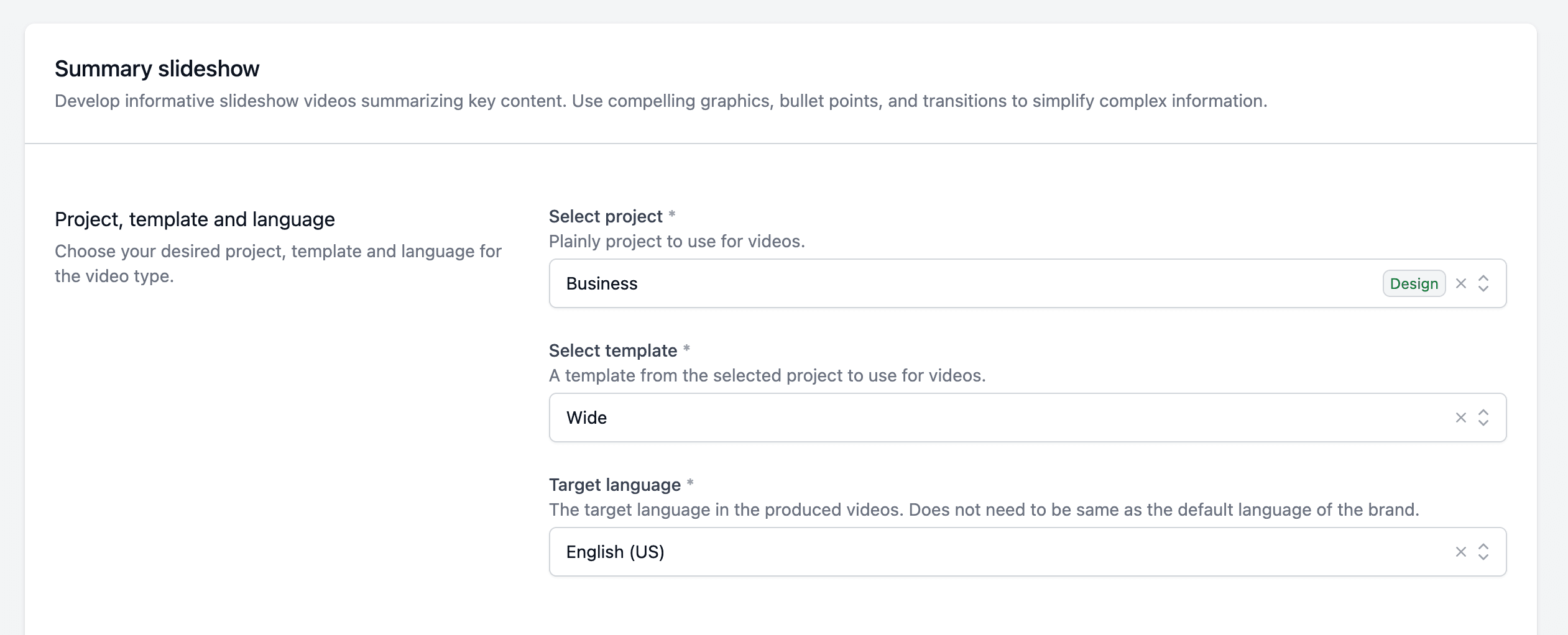
Fill in the rest of the form, and click on Create.
Video creation
You’re now able to render videos. Video rendering is initiated by adding an article to your brand. This triggers the creation of all video types enabled for this brand.
Add an article from Articles or the Brand details page. Provide the Article URL and Article text to start the rendering process.
We’re adding a scraper that will automatically pull the article body from the URL, so you won’t need to copy and paste.
You will be redirected to the Article Details page where you will see the status of your video types and other useful information about the article.
All the video types will automatically start processing. Plainly will first process your article, then create all needed parameters for the rendering, so that the render can be started. After the rendering is done you can preview the videos by clicking on any of the video types.
It can occur that title and main article image can not be scraped from the given article link. We depend on the OpenGraph meta tags, which are usually available. If you are experiencing this issue, please check if the article has the OpenGraph meta tags and if they are properly set up. Also, some sites block access for non-human visitors by using security tools like Cloudflare.
Using the API
Since VideoGenius feature is built on top of the Plainly API, all of its features are accessible by our API. This means that you can use Plainly’s API to automate the creation of videos. To find out more, check out our API documentation .